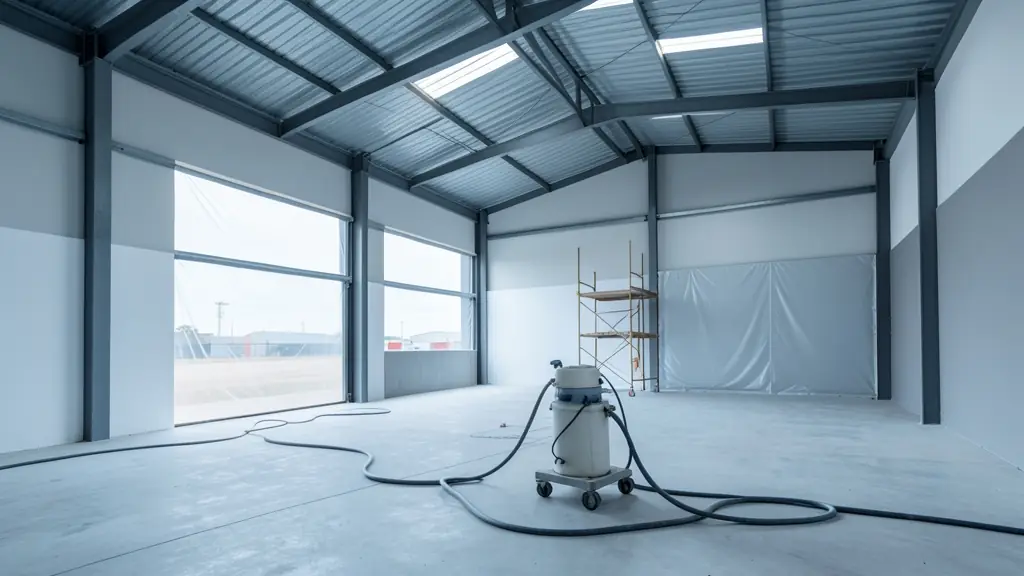
Spray painting with an airless sprayer puts paint on large walls, ceilings, roofs and steelwork much faster than a roller, and it reaches into textured plaster, corrugations and roof trusses that brushes struggle with. The catch is everything that must not get paint on it: windows, floors, cars, plants and the neighbour's wall. Good spray painters spend real time masking, control overspray and usually back-roll walls for an even finish. This page is about spraying buildings, not cars. Describe the job and spray painting contractors near you quote you directly. Requests are free and you need not accept.
When spraying makes sense
Airless spray painting pays off where there is a lot of open area and little to protect:
- Empty new houses and units before floors and fittings go in.
- Warehouse walls, ceilings, steel trusses and roof sheeting.
- Large ceilings, especially high or textured ones.
- Roofs, IBR and corrugated sheeting, after cleaning and rust treatment.
- Long boundary walls and textured exterior walls.
In a furnished home with many rooms, a brush and roller is often quicker once masking is counted.
Masking and overspray control
Before spraying, everything not being painted is covered: floors with drop sheets, windows and frames with plastic and tape, light fittings, switches and fittings removed or wrapped. Outside, cars are moved and paving and plants covered. Wind carries fine mist a long way, so painters should not spray outside on windy days and should use shields near boundaries. Paint mist is not something to breathe: sprayers and anyone nearby need a respirator, and the area should be ventilated.
Spray, then back-roll
Spraying lays a heavy, even film fast, but on walls many painters back-roll the wet coat to push paint into the surface and even out the texture. Preparation does not change: walls are still washed, scraped, filled, sanded and primed. Coats and spread rates come from the tin's data sheet, and spraying can use more paint than rolling because of overspray. See spray painting machines for the equipment.
How spray painting is priced
Spray painting is quoted per m² or per job after a site visit. Masking time, height and access, the coating and the number of coats drive the price. Compare quotes on the same scope, and ask who removes the masking and cleans up. For large buildings, see commercial painting.
What to include in your request
- What is being sprayed: walls, ceilings, roof, steel
- Rough area in m² and the height
- Empty or occupied, inside or outside
- What must be protected nearby
- Paint type and colour, if you know it
Spray Painting for different clients
- Homeowners: big textured ceilings, long boundary walls or an empty house sprayed quickly
- Landlords and sellers: an empty flat or house sprayed between tenants to keep downtime short
- Body corporates and estates: block walls and boundary walls sprayed with careful masking around parked cars
- Shops, offices and restaurants: large shop and office ceilings sprayed overnight with fittings masked
- Factories, farms and mines: warehouse walls, steel trusses and roof sheeting sprayed in one pass
- Builders and developers: new builds sprayed before floors and fittings so masking stays simple
- Schools, churches and public buildings: school halls, church halls and gym ceilings sprayed during the school holidays
- Painters and contractors: contractors with airless sprayers taking on large areas for other painters
Frequently asked questions
Is spray painting a wall better than rolling it?
Can a ceiling be spray painted in an occupied house?
Do you do car spray painting?
Should I hire a sprayer or a spray painter?
Spray Painting by province and city
- Johannesburg
- Pretoria
- Centurion
- Midrand
- Sandton
- Randburg
- Roodepoort
- Krugersdorp
- Randfontein
- Germiston
- Boksburg
- Benoni
- Kempton Park
- Alberton
- Vanderbijlpark
- Vereeniging
- Durban
- Pinetown
- Pietermaritzburg
- Richards Bay
- Newcastle
- Ladysmith
- Gqeberha (Port Elizabeth)
- East London
- Kariega (Uitenhage)
- Mthatha
- Cape Town
- Bellville
- Paarl
- Stellenbosch
- George
- Worcester
- eMalahleni (Witbank)
- Middelburg
- Secunda
- Mbombela (Nelspruit)
- Rustenburg
- Brits
- Klerksdorp
- Potchefstroom
- Mahikeng
- Polokwane
- Tzaneen
- Kimberley
- Upington
- Bloemfontein
- Welkom
- Sasolburg